What Is Answer Engine Optimization? A Plain-English Guide for 2026
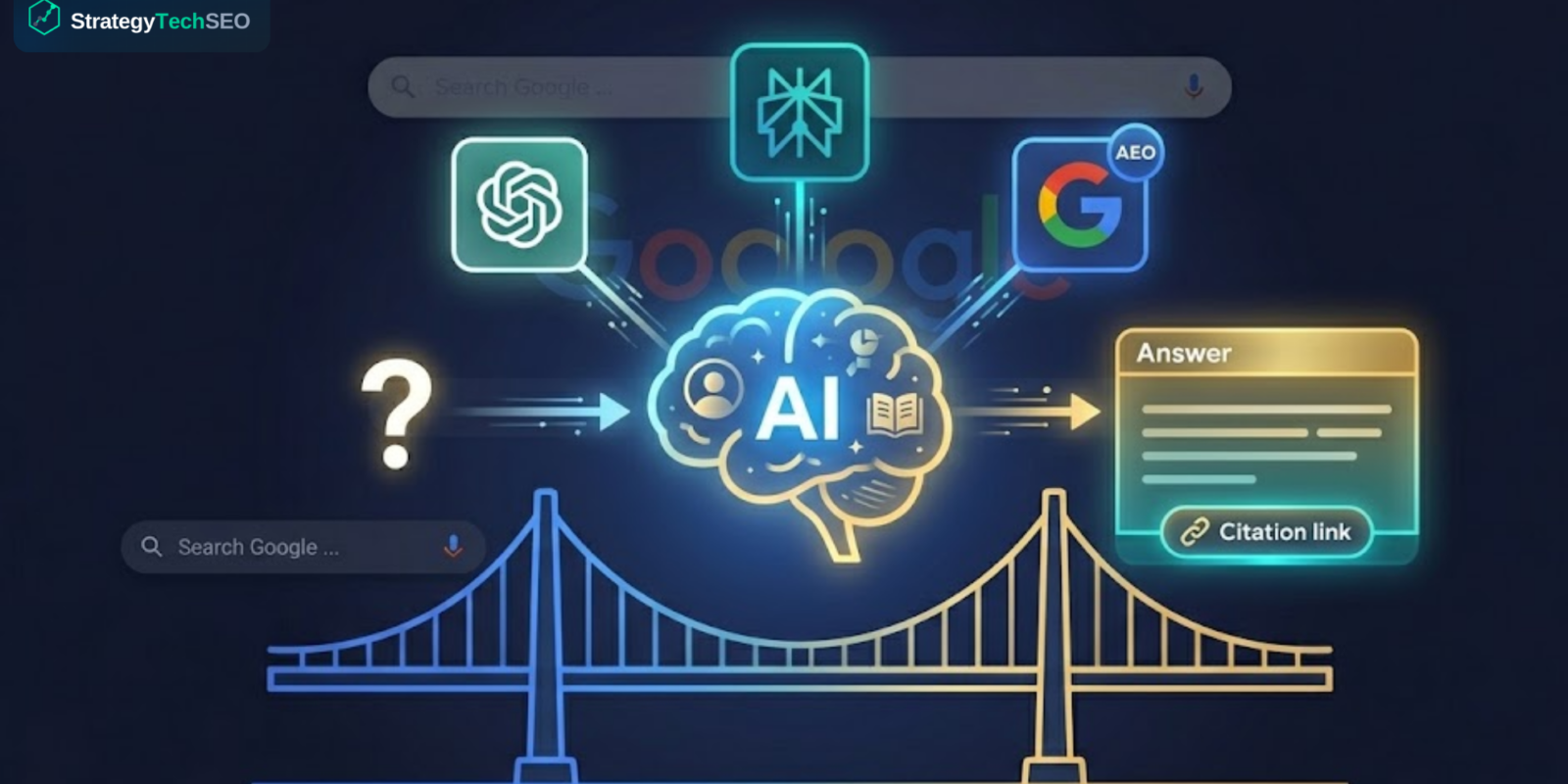
What is answer engine optimization, and why should every marketer understand it in 2026? The short explanation: AEO is answer engine optimization (AEO), the practice of optimizing content so that AI-powered platforms can extract, cite, and deliver your information directly to users as answers. Instead of competing for ten blue links on a search results page, you are competing to become the source that ChatGPT, Perplexity, Google AI Overviews, and voice assistants pull from when someone asks a question.
If traditional SEO is about ranking in search engines, AEO is about becoming the answer itself. And that distinction is not a minor adjustment to your marketing playbook. It is a fundamental shift in how visibility works online.
Gartner has predicted that traditional search engine volume will drop 25 percent by 2026 as users shift to AI chatbots and virtual assistants. ChatGPT alone now handles over 2 billion queries daily. AI referral traffic to websites grew 527 percent year-over-year through mid-2025. These numbers represent a structural change in user behavior, not a passing trend. And most marketing teams are not equipped for it.
What Is Answer Engine Optimization (AEO)?
Answer engine optimization is the practice of structuring and optimizing content so that AI systems can extract direct answers from your pages and present them to users. Where traditional search engine optimization focuses on earning clicks from a ranked list of links, AEO focuses on earning citations, mentions, and direct placements inside AI-generated responses.
The term “answer engine” refers to any platform that delivers direct answers instead of a list of links. This includes Google’s AI Overviews and featured snippets, ChatGPT, Perplexity, Microsoft Copilot, voice assistants like Siri and Alexa, and any system powered by large language models that synthesizes information from the web into a single response.
AEO is not a replacement for SEO. It is an extension of it. The best-performing AEO content is also well-optimized for traditional search. But AEO adds a layer of optimization that most traditional SEO strategies do not address: making your content machine-readable, extractable, and citable by AI models that construct answers from multiple sources.
How Answer Engines Actually Work
Understanding how answer engines process information is essential for building effective AEO strategies. The process is fundamentally different from how traditional search engines rank pages.
When a user asks a question on an answer engine, the system does not paste that question into a search index and return a list of matching pages. Instead, it breaks the question into smaller sub-queries, searches for information relevant to each piece, retrieves content from multiple sources, and synthesizes everything into a single coherent response. The best answer engines also include citations that link back to the original pages they pulled from.
The AI models behind these platforms prioritize content that demonstrates expertise, provides verifiable claims, and is formatted in ways that make extraction easy.
Different platforms also work differently under the hood. ChatGPT uses Google’s search index via SearchGPT. Perplexity runs its own web crawler called PerplexityBot. Google AI Overviews pull from Google’s own search index. This means your content needs to be visible and well-structured across multiple indexing systems, not just one.
AEO vs. Traditional SEO: What Changes and What Stays the Same
The relationship between AEO and traditional SEO is additive, not adversarial. Most AEO strategies also improve your SEO performance, because well-structured, authoritative, data-backed content ranks better in Google and gets cited more frequently by AI systems.
| Dimension | Traditional SEO | Answer Engine Optimization |
|---|---|---|
| Primary Goal | Rank on search results pages | Become the cited source in AI-generated answers |
| Success Metric | Rankings, impressions, CTR | Citation frequency, AI referral traffic, share of voice |
| Content Structure | Keyword-optimized pages | Question-based, extractable sections with structured data |
| Key Signals | Backlinks, on-page SEO, technical health | Entity data, schema markup, E-E-A-T, citation building |
| Audience Behavior | Users click through ranked links | Users receive synthesized answers with source citations |
| Platforms | Google, Bing, Yahoo | ChatGPT, Perplexity, Google AI Overviews, voice assistants |
The key insight is that AEO does not replace SEO. It extends your visibility into the platforms where an increasing share of user questions are being asked and answered. A page that ranks well on Google is also more likely to be cited by Google AI Overviews. But a page that is also structured for extraction, uses structured data, and answers questions directly has a far better chance of being cited by ChatGPT and Perplexity as well.
Why AEO Is the Skill Gap Most Marketers Have Right Now
Most marketing teams were trained on traditional SEO: keyword research, on-page optimization, link building, and technical audits. Those skills remain valuable. But they are no longer sufficient on their own.
The shift from search engines to answer engines represents a change in user behavior that has outpaced most marketing strategies. Users are not searching the way they used to. They are asking AI-powered tools complex, conversational questions and expecting synthesized answers, not a list of links to sort through.
The audience is already there. The question is whether your content is structured to reach them. The marketers and agencies that close this gap first will capture a disproportionate share of AI-driven visibility. Those who treat AEO as optional will watch their brand disappear from the conversations their audience has with AI systems every day.
The Core AEO Strategies That Drive Visibility
Effective AEO strategies build on a strong SEO foundation while adding the specific optimizations that AI models and answer engines reward. Here are the six areas that matter most.
Entity Optimization
Make your brand machine-readable. Ensure your organization, people, products, and services are represented as clear entities across your site, your Google Business Profile, Wikipedia, Wikidata, and industry directories. AI systems use entity data to determine who you are and whether to cite you.
Structured Data
Implement structured data using Schema.org markup. FAQ schema, HowTo schema, Article schema, and Speakable schema all help AI models understand your content structure and extract relevant passages. This is the technical layer that makes your created content citable.
Question-Based Content
Build content around the actual user questions your audience asks. Use headings that mirror natural language queries. Lead each section with a direct answer, then expand with supporting detail. This answer format aligns with how answer engines extract and deliver information.
Citation Building
Earn brand mentions and references from authoritative, well-indexed sources. Large language models are more likely to cite brands that appear consistently across reputable publications, industry sites, and data sources. Think of this as link building evolved for the AI era.
E-E-A-T Reinforcement
Demonstrate experience, expertise, authoritativeness, and trustworthiness across every piece of created content. Author bios, credentials, editorial review processes, and transparent sourcing are the trust signals that both search engines and AI systems evaluate.
AI Visibility Auditing
Regularly test how your brand appears in AI answers. Search for your target queries on ChatGPT, Perplexity, and Google AI Overviews. Track whether you are being cited, what competitors are being cited instead, and where your content gaps are.
How to Structure Content for Answer Engines
Structuring content for answer engines follows a simple principle: every section of your page should be independently understandable and extractable. AI systems do not read your entire article and summarize it. They identify specific passages that answer specific questions and incorporate them into their responses.
This means your content architecture needs to work at the section level, not just the page level.
Common Mistakes to Avoid
- Burying answers deep in paragraphs. If the answer to a key question does not appear until paragraph eight, no answer engine will find it. Lead with the answer, then elaborate.
- Writing for keywords instead of questions. Answer engines respond to user questions, not keyword strings. Frame your content around the questions your audience actually asks.
- Ignoring structured data. Without structured data, your content is harder for AI models to parse. Schema markup is not optional for AEO. It is a core requirement.
- Publishing without clear authorship. Content with no identifiable author, no credentials, and no editorial transparency gets deprioritized by AI systems that evaluate trustworthiness.
Content that is well-structured for answer engines also performs better in traditional search. Clear headings, direct answers, structured data, and strong E-E-A-T signals improve your chances of earning featured snippets, People Also Ask placements, and higher organic rankings. AEO and SEO reinforce each other.
Measuring AEO Success: The Metrics That Matter
Traditional SEO measures success through rankings, impressions, and click-through rates. AEO introduces a new set of metrics that reflect how your content performs inside AI-generated answers.
| Metric | What It Measures | Why It Matters |
|---|---|---|
| Citation Frequency | How often your content is cited in AI responses | Direct indicator of AI visibility and content authority |
| Citation Share of Voice | Your citation rate vs. competitors for target queries | Measures competitive positioning in AI answers |
| AI Referral Traffic | Visitors arriving from AI platforms | Quantifies real traffic impact from AEO efforts |
| Brand Mentions | Frequency of brand references across AI outputs | Tracks brand awareness within AI ecosystems |
| Conversion from AI Visitors | Conversion rate of AI-referred traffic | AI visitors convert at 4.4x the rate of standard organic |
These metrics are newer and less standardized than traditional SEO KPIs. But they are essential for understanding whether your AEO strategies are working. The brands that start measuring now will have a significant data advantage as AI search continues to grow.
Getting Started With AEO in 2026
Answer engine optimization does not require you to rebuild your content strategy from scratch. It requires you to extend your existing SEO foundation with the specific practices that AI-powered answer engines reward.
- Audit your AI visibility. Search for your top 10 target queries on ChatGPT, Perplexity, and Google AI Overviews. Note where you are cited, where competitors appear instead, and where no clear source is referenced.
- Restructure existing content. Take your highest-performing pages and restructure them so each section leads with a direct answer, uses clear headings that mirror user questions, and can stand on its own as an extractable passage.
- Implement structured data. Add FAQ, HowTo, Article, and Organization schema to your key pages. This structured data layer makes your content machine-readable, significantly improving your chances of being cited.
- Build your entity footprint. Ensure your brand, key people, and products are consistently represented across your website, Google Business Profile, industry directories, and authoritative third-party publications.
- Track and iterate. Set up a monthly cadence for auditing your AI visibility, tracking citation frequency, and identifying content gaps. AEO is not a one-time project. It is an ongoing practice that compounds over time.
The marketers who build AEO into their strategy now are not just preparing for the future; they are shaping it. They are capturing the AI-driven traffic and brand mentions that their competitors are leaving on the table today. Answer engine optimization is the bridge between the SEO you already know and the AI visibility your brand needs. The sooner you cross it, the further ahead you will be.
Position Your Brand Where AI Answers Are Built
Answer engine optimization is not optional anymore — it is where your audience is going. StrategyTech SEO helps brands build the content structure, entity authority, and AI visibility strategies that drive citations, traffic, and conversions from the platforms that matter most in 2026.
Sources & References
- CXL. “Answer Engine Optimization (AEO): The Comprehensive Guide for 2026.” cxl.com
- Frase.io. “Answer Engine Optimization: Complete AEO Guide [2026].” frase.io
- Forbes. “Answer Engine Optimization (AEO): What Brands Need to Know.” forbes.com
- SEO.com. “AEO vs. SEO: How Answer Engines Are Changing Digital Marketing.” seo.com
- Conductor. “What Is Answer Engine Optimization? Enterprise Guide to AEO.” conductor.com
- Amsive. “Answer Engine Optimization (AEO): Your Complete Guide to AI Search Visibility.” amsive.com
- LLMrefs. “Answer Engine Optimization (AEO): The Complete Guide for 2026.” llmrefs.com
- Evergreen Media. “Answer Engine Optimization (AEO): AI Visibility in 2026.” evergreen.media
- Marketing Tech News. “Answer Engine Optimization (AEO): A Comprehensive Guide for 2026.” marketingtechnews.net

StrategyTech SEO
StrategyTech SEO helps businesses grow organic visibility through technical audits, on-page optimization, and data-driven search strategies. We turn SEO from guesswork into measurable results.