Long Tail Keywords: Why They Convert 2.5x Better Than Short Keywords
Most digital marketers are chasing the wrong keywords. They spend months trying to rank for high-volume head terms with thousands of monthly search queries, burning budget on keywords competition they cannot win, and wondering why traffic does not turn into revenue. Meanwhile, long tail keywords quietly account for 91.8% of all search queries and convert at 2.5 times the rate of those short, glamorous terms everyone fights over.
That is not a minor gap. It is a fundamental misallocation of resources that affects every part of your SEO strategy, from content planning to paid campaigns. This guide uses the data to show why the obsession with high-volume terms is costing you conversions and what to do instead.
What Are Long Tail Keywords and Why Do They Matter?
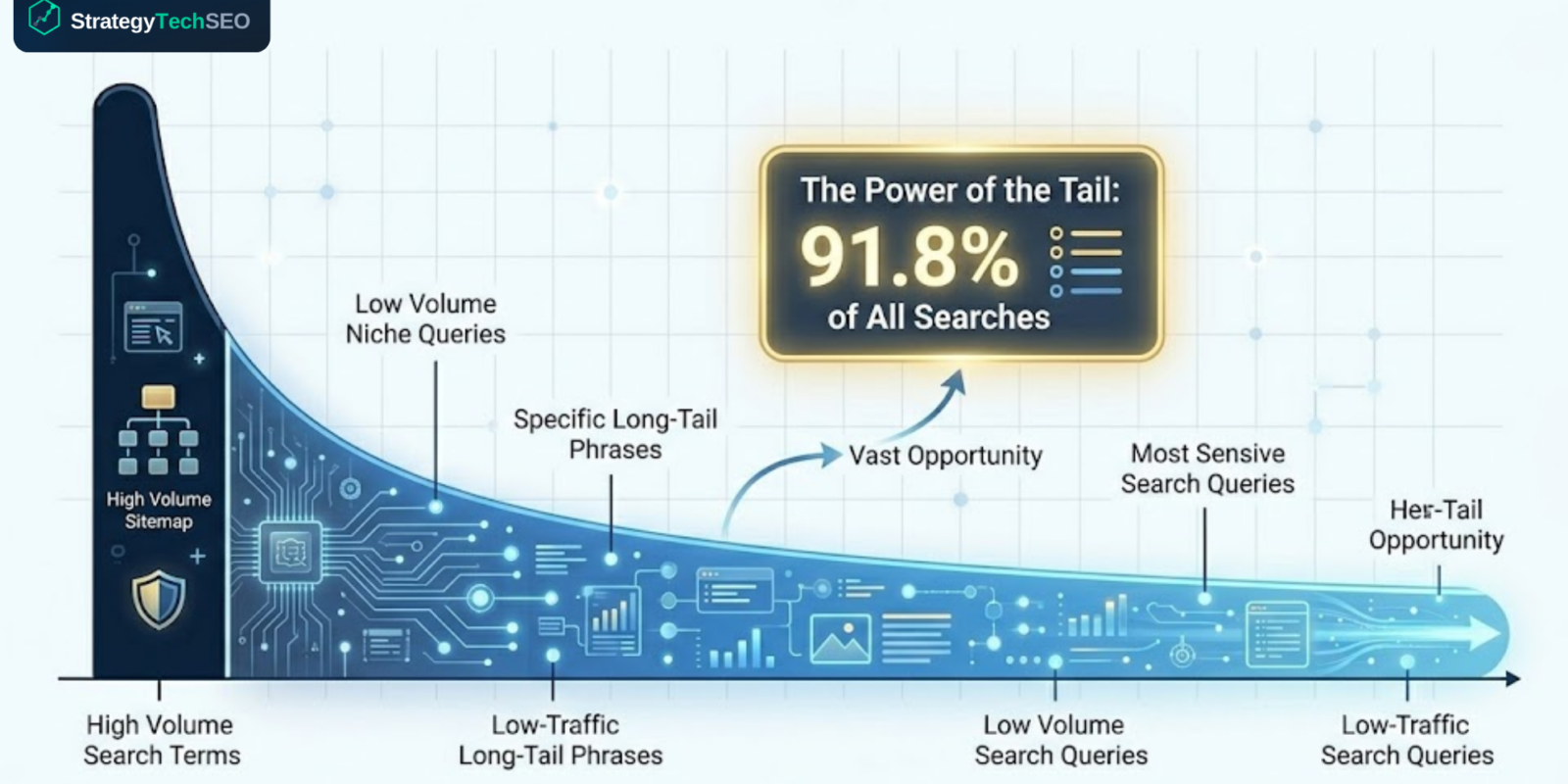
Long-tail keywords are specific, multi-word search phrases that typically have lower individual search volumes but collectively account for the vast majority of Google searches. The term comes from the shape of the search demand curve: a small number of head terms generate high volume on the left, while an enormous “tail” of specific queries stretches out to the right.
A broad keyword like “running shoes” might get 100,000 searches per month. A long tail version like “best running shoes for flat feet under 150” gets a fraction of that volume. But the person searching that specific phrase knows exactly what they want, what their budget is, and what problem they need solved. That specificity in search behavior is what makes long-tail keywords so valuable.
According to Backlinko’s analysis of 306 million keywords, 91.8% of all search queries are long tail keywords. The remaining 8.2% are head terms. Yet most SEO strategies allocate most of their effort to that 8.2%.
The Conversion Data That Changes Everything
The conversion gap between short tail and long-tail keywords is not subtle. Research consistently shows that long tail keywords convert at an average rate of 36%, while broader head terms convert at roughly 2.35%. That means long tail traffic converts at more than 15 times the rate of short tail traffic in some contexts, and at a minimum 2.5 times better across most industry benchmarks.
| Metric | Short Tail Keywords | Long Tail Keywords |
|---|---|---|
| Average Conversion Rate | 2.35% | 36% |
| Share of All Searches | 8.2% | 91.8% |
| Competition Level | Extreme | Low to Moderate |
| Cost Per Click | High | Significantly Lower |
| Search Intent Clarity | Ambiguous | Specific and Actionable |
| Time to Rank | 2-3+ Years | Weeks to Months |
Why does this happen? The answer is search intent. When someone types a broad keyword like “CRM software” into a search engine, they could be doing anything: researching the category, writing a report, comparing options, or just curious. The intent is unclear, and unclear intent leads to lower conversion rates.
When someone searches “best CRM software for small real estate teams with email integration,” they are ready to make a decision. They have defined their industry, their team size, and the feature they need. That level of specificity means the visitor arrives at your page already aligned with what you offer. Your content does not need to convince them they have a problem. It needs to show them you have the solution.
Why High-Volume Head Terms Are Misleading
The obsession with high-volume keywords stems from a reasonable but outdated assumption: more searches mean more potential traffic, which means more revenue. The problem is that the assumption ignores three realities of modern search.
- Keywords competition for head terms is extreme. The pages rank on page one for terms like “SEO tools” or “email marketing” are dominated by billion-dollar companies with massive link profiles and dedicated content teams. A mid-size business competing for those terms is bringing a bicycle to a Formula 1 race.
- High-volume terms attract low-intent traffic. A visitor who searched “email marketing” and landed on your page is statistically unlikely to convert. They are in research mode, not buying mode. Your bounce rate goes up, your conversion rate goes down, and your analytics look busy, but your pipeline stays empty.
- Ranking for head terms takes significantly longer. Studies show that most pages ranking on page one for high-volume keywords are at least two to three years old. Long tail keywords, by contrast, are where newer content can compete and win within weeks or months.
How to Find Long Tail Keywords That Drive Conversions
Finding high-converting long tail keywords requires a shift in how you approach keyword research. Instead of starting with volume, start with intent.
Use a Keyword Tool
Use a keyword tool built for long tail discovery. Tools like Semrush, Ahrefs, and Keywords Everywhere let you filter by word count, search volume range, and keyword difficulty. Set your filters to show phrases with three or more words and low to moderate difficulty. This is where the conversion opportunities live.
Mine Your Own Data
Google Search Console is a rich source of long tail keywords. It shows you the exact queries people use to find long tail keywords and land on your site. Sort by impressions with low click-through rates to identify long tail queries where you are visible but not yet earning clicks.
Analyze Competitor Gaps
Use your keyword tool to see which long tail terms your competitors rank for that you do not. These gaps reveal topics your audience is searching for that don’t yet have strong content from your brand.
Listen to Your Audience
Customer support tickets, sales call transcripts, forum discussions, and Reddit threads are rich with the exact language your audience uses. That language is often the precise wording of long tail searches that no keyword tool surfaces on its own.
Check People Also Ask and autocomplete. Google searches generate “People Also Ask” boxes and autocomplete suggestions that reveal the specific questions users ask around your topic. These are ready-made long tail keyword opportunities that align directly with search intent.
How to Create Content That Ranks for Long Tail Keywords
Once you have identified your target long tail keywords, the content you build around them needs to match the specificity of the search. This is where most content strategies fail. They identify the right keywords but then produce generic content that does not deliver on the promise of the query.
- Answer the specific question first. Every page you build should answer the specific question behind the keyword within the first two paragraphs. If someone searches “how to set up email automation for Shopify stores,” your page should address Shopify email automation directly, not email marketing in general. The search engine rewards content that precisely matches intent, and users reward it with conversions.
- Structure sections around related long-tail variations. A single well-structured page can rank for dozens of long tail queries if each section addresses a distinct sub-question. Use clear headings that mirror how users phrase their search queries. This is how one page that creates content around a cluster of related long-tail keywords captures more total traffic than a page optimized for a single head term.
- Include specific data, examples, and actionable steps. Long tail searchers are looking for depth, not surface-level overviews. The ultimate guide that ranks for a head term is often too broad to satisfy a long tail query. Instead, build focused, thorough pages that treat each long tail topic as the main event, not an afterthought.
Long Tail Keywords and the Future of Search
The shift toward conversational search via AI chatbots, voice assistants, and AI-powered search results is making long-tail keywords more important, not less. When users speak to Siri, Alexa, or ChatGPT, they ask full questions in natural language. Those queries are inherently long tail.
“Tell me about” searches increased 70% from 2024 to 2025. Users are searching in longer, more conversational phrases than ever before. The brands that align their content with this behavior are the ones capturing both traditional organic traffic and citations from AI-powered platforms.
Long tail keywords are not a niche tactic for small websites. They are where 91.8% of all search behavior lives, where conversion rates are highest, where competition is lowest, and where the future of search is heading. The digital marketers who shift their strategy toward long tail specificity will outperform those still chasing volume every time.
Stop Chasing Volume. Start Capturing Conversions.
Long tail keywords are where 91.8% of real search behavior lives and where conversion rates are 2.5x higher. StrategyTech SEO helps brands build keyword strategies that target the specific, high-intent searches your audience is already making.
Sources & References
- Backlinko. “We Analyzed 306M Keywords. Here’s What We Learned About Google Searches.” backlinko.com
- Embryo. “30 Statistics About Long-Tail Keywords.” embryo.com
- Circulate Digital. “45 Statistics About Long-Tail Keywords (2025).” circulatedigital.com
- Neil Patel. “Conversion Rate by Keyword Length: Long-Tail Keywords Win.” neilpatel.com
- Yotpo. “Long-Tail Keywords: The Ultimate Guide for 2026.” yotpo.com
- Commit Agency. “How Long-Tail Keywords Boost SEO, Content, and Conversions.” commitagency.com
- Keywords Everywhere. “Long-Tail SEO: Secrets to Explosive Traffic [2026].” keywordseverywhere.com

StrategyTech SEO
StrategyTech SEO helps businesses grow organic visibility through technical audits, on-page optimization, and data-driven search strategies. We turn SEO from guesswork into measurable results.