What Is E-E-A-T in SEO? Why Google Uses It to Evaluate Your Content
What is E-E-A-T in SEO, and why does it keep showing up in every conversation about content quality and rankings? If you work in search engine optimization (SEO), you have probably heard that E-E-A-T is a ranking factor. That claim is everywhere. It is also wrong. E-E-A-T is not a metric Google plugs into its ranking algorithms. There is no E-E-A-T score assigned to your pages. What E-E-A-T actually represents is something more foundational: it is the quality framework behind Google’s search quality rater guidelines, the document that trains thousands of human evaluators to assess whether search results are genuinely helpful, accurate, and trustworthy.
Understanding this distinction changes how you approach content. Instead of chasing a score that does not exist, you focus on building the real-world signals that Google’s systems are designed to reward. That is what this guide is about.
What E-E-A-T Stands For: Experience, Expertise, Authoritativeness, and Trustworthiness
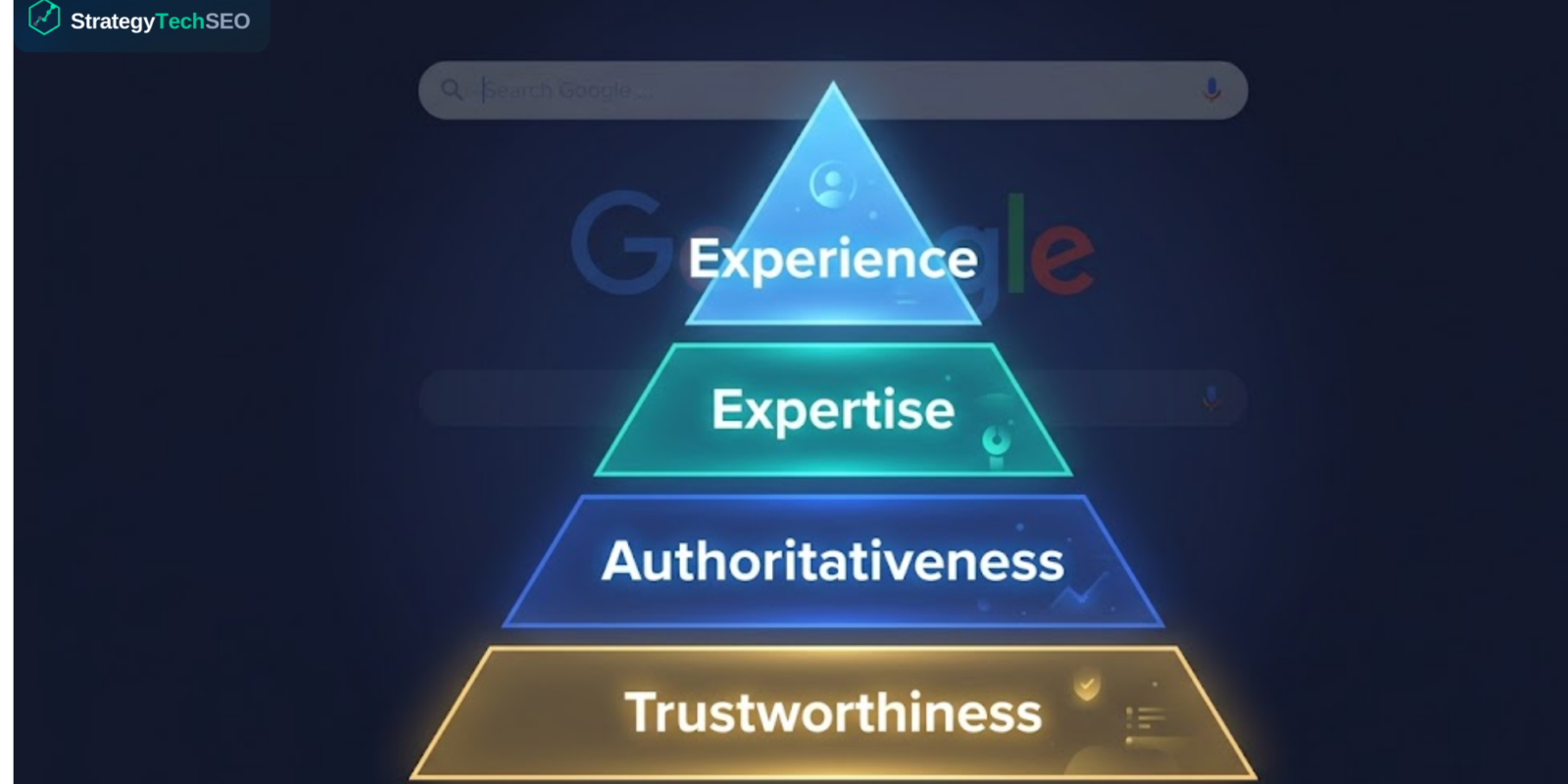
The acronym stands for Experience, Expertise, Authoritativeness, and Trustworthiness. The framework originally launched as E-A-T in 2014 as part of Google’s search quality rater guidelines. In December 2022, Google added a second E for Experience, formally recognizing that first-hand experience with a topic carries real weight when evaluating content quality. The update reflected a simple truth: search engine optimization (SEO) professionals had long observed that content rooted in real experience performed better, and Google made that observation official.
The acronym describes how Google wants its quality raters to evaluate content at a high level. It is the lens through which evaluators ask: Does this content come from someone who knows what they are talking about, and can the reader trust what they are reading?
E-E-A-T Is Not a Direct Ranking Factor. Here Is What It Actually Is.
This is the most important misconception to clear up. Google has stated explicitly that there is no E-E-A-T score and that it is not a direct ranking factor. Quality raters use the framework to evaluate search results, but their assessments do not directly move your rankings. Rater feedback is used to test and refine Google’s ranking algorithms over time, not to rank individual pages.
Think of it this way: E-E-A-T describes the qualities that Google’s automated systems are designed to detect. When Google’s algorithms evaluate backlinks, content depth, author reputation, site history, and user engagement, they are measuring signals that reflect expertise, authoritativeness, and trustworthiness. E-E-A-T is the framework that gives those signals meaning.
This distinction matters because it changes your strategy. Instead of trying to “tick the E-E-A-T box,” you invest in the underlying signals: real expertise, verifiable experience, editorial standards, and a reputation that trustworthy sources recognize.
The Four Signals and What They Mean for Your Content
Each letter in E-E-A-T evaluates a different dimension of content quality. Understanding what each one measures helps content creators build pages that align with what Google’s systems reward.
Experience
Does the creator have first-hand experience with the topic? For product reviews, travel guides, or how-to content, Google wants evidence that the person actually used the product, visited the place, or completed the process. Original photos, personal observations, and specific details signal real experience.
Expertise
Does the creator have the knowledge or skill to speak on this subject matter with authority? A medical article written by a licensed physician carries more weight than one written by a generalist. Expertise can be formal (credentials, education) or informal (years of practical experience in a field).
Authoritativeness
Is the creator or the website recognized as a go-to source in this space? Authority is built through mentions on reputable sites, backlinks from trustworthy sources, industry recognition, and a track record of publishing reliable content on the subject matter.
Trustworthiness
Google has stated that trustworthiness is the most important member of the E-E-A-T family. Without trust, the other elements lose their value. Trust is demonstrated through transparency, accurate information, clear sourcing, secure sites, and honest representation of who is behind the content.
The four signals work together. A page can show deep expertise but lose all credibility if the site is not transparent about who wrote it or where the information came from. Trustworthiness is the foundation on which everything else rests.
Why E-E-A-T Matters Even More for Your Money or Your Life Content
Google applies a higher standard to pages that could significantly impact a person’s health, financial stability, safety, or well-being. These are called money or your life (YMYL) topics. Medical advice, legal guidance, financial planning, and news reporting all fall into this category.
For YMYL content, weak E-E-A-T signals can result in pages being pushed far down in search results or excluded entirely from high-visibility placements. Google’s systems are specifically calibrated to surface content from credible, qualified sources when the stakes are high. If your site publishes YMYL content, demonstrating experience, expertise, and authoritativeness is not optional. It is the cost of entry.
| Content Type | E-E-A-T Standard | What Google Looks For |
|---|---|---|
| YMYL (Health, Finance, Legal) | Highest | Credentialed authors, citations, editorial review, institutional backing |
| Product Reviews | High | First-hand testing, original photos, specific pros/cons from real use |
| News & Current Events | High | Transparent sourcing, named journalists, editorial standards |
| How-To & Educational | Moderate | Demonstrated skill, step-by-step detail, practical experience |
| Entertainment & Lifestyle | Standard | Personal voice, originality, audience engagement |
E-E-A-T in the Age of AI-Generated Content
The rise of AI-generated content in 2025 and 2026 has made E-E-A-T more relevant than ever. When anyone can produce a 2,000-word blog post in seconds, the differentiator is no longer content volume. It is content credibility.
Google’s helpful content systems are designed to reward content that demonstrates genuine knowledge, not content that simply aggregates information from other sources. AI-generated content that lacks original perspective, first-hand experience, or verifiable expertise tends to perform poorly against content written or reviewed by real subject matter experts.
This does not mean AI tools are off-limits for content creators. It means the output must be shaped by someone with real expertise and reviewed for accuracy. The experience, expertise, and authoritativeness signals in E-E-A-T are precisely what separate useful AI-assisted content from the low-quality flood that Google is actively working to filter out. A blog post written entirely by AI with no editorial oversight, no original perspective, and no identifiable author sends exactly the signals that Google’s helpful content systems are designed to suppress.
If you create content grounded in real experience and genuine expertise, you have an advantage over every competitor relying on generic AI output. E-E-A-T rewards exactly the kind of depth and authenticity that AI alone cannot produce.
How to Demonstrate E-E-A-T Across Your Site
E-E-A-T is not a one-time optimization. It is a set of ongoing practices that build credibility with both users and Google’s systems over time. Here are the areas where content creators and site owners should focus.
- Author transparency. Publish detailed author bios with credentials, experience, and links to external profiles. Make it clear who is responsible for each piece of content and why they are qualified.
- First-hand evidence. Include original research, personal observations, proprietary data, or real-world examples. For product reviews, add your own photos, test results, and specific usage context.
- Editorial standards. Show that content is reviewed, fact-checked, and updated regularly. Include “medically reviewed by” or “reviewed by” labels where appropriate. Display last-updated dates prominently.
- Source your claims. Link to trustworthy sources — peer-reviewed research, official documentation, and recognized authorities. Unsupported claims erode trust, especially on YMYL topics.
- Build external reputation. Earn mentions, citations, and backlinks from authoritative sites in your field. Contribute guest articles, participate in industry publications, and maintain consistent NAP information for local signals.
- Site-level trust signals. Maintain HTTPS, provide clear contact information, publish transparent privacy policies, and make terms of service accessible. These are foundational trust markers that Google’s systems evaluate at the site level.
None of these practices requires special tools or secret techniques. They require commitment to accuracy, transparency, and genuine expertise. E-E-A-T compounds over time. A site that consistently publishes well-sourced, expert-reviewed content will gradually earn the authority signals that Google’s ranking algorithms are built to recognize. That is what separates sites that build lasting visibility from those that chase short-term tricks.
Build Content That Google Trusts and Users Value
E-E-A-T is not a checkbox. It is a long-term content standard that determines whether your site earns visibility or gets filtered out. StrategyTech SEO helps brands build the expertise, authority, and trust signals that Google’s systems reward.
Sources & References
- Google. “Creating Helpful, Reliable, People-First Content.” Google Search Central. developers.google.com
- Google. “Search Quality Rater Guidelines.” services.google.com
- Keywords Everywhere. “Google E-E-A-T Guidelines: An Overview (2026 Playbook).” keywordseverywhere.com
- Rankability. “Is E-E-A-T a Google Ranking Factor? Complete Guide.” rankability.com
- ClickPoint Software. “E-E-A-T as a Ranking Signal in AI-Powered Search.” clickpointsoftware.com
- Search Engine Journal. “Google E-E-A-T: What Is It & How To Demonstrate It For SEO.” searchenginejournal.com
- SEO.com. “What Is E-E-A-T and Why Is It Important for SEO?” seo.com

StrategyTech SEO
StrategyTech SEO helps businesses grow organic visibility through technical audits, on-page optimization, and data-driven search strategies. We turn SEO from guesswork into measurable results.