How to Build a Content Strategy That Works for SEO and AI Search
A content strategy for SEO 2026 that moves the needle looks nothing like the publish-and-pray methods of the last ten years. Search engines and AI assistants now judge content by its intent, depth, and trust signals. If your plan stops at picking keywords and hitting a post count, you are running a content factory, not a growth engine. The gap between the two shapes determines whether your pages earn spots in AI platforms or fade into the noise.
This guide shows how to build a plan that earns results across both classic search engines and the fast-growing world of AI powered search. The core of the method rests on three pillars: intent mapping, the topic cluster model tuned for the AI era, and the page-level signals that help both humans and machines read your content.
Why Content Output Is Not Content Strategy
Posting 20 blogs a month without a clear plan is like building rooms without a blueprint. You end up with pages that overlap, keywords that fight each other, and a site layout that confuses both crawlers and readers. Too many teams confuse volume with SEO strategy. They track the number of indexed pages, but they should track the quality of the traffic those pages drive.
A real content strategy for SEO starts with a question most content plans skip: what does the person typing this search really need right now? That one question is the door to intent mapping, and it changes how you plan, write, and link every piece of content on your site.
The rise of AI generated content widens this gap. When anyone can spin up 50 posts in an hour, the edge shifts from volume to aim. AI systems that drive search results and power AI assistants are built to spot content that shows lived experience, fresh thinking, and real depth. A content team that treats each keyword as a one-off will always lose to one that treats it as part of a larger system.
Intent Mapping: The Base of Real SEO Gains
Intent mapping is the discipline of categorizing every target keyword by the underlying motivation behind the search. The four primary classifications are informational, navigational, commercial investigation, and transactional. In 2026, effective intent mapping extends beyond these categories. It incorporates the buyer journey stage, urgency indicators, and the contextual variables that determine how the same keyword should be addressed depending on who is searching and why.
Consider the phrase project management software. A person in the awareness stage needs an educational overview. A person evaluating options needs a detailed comparison. A person ready to purchase needs pricing transparency and a registration pathway. One page cannot adequately serve all three audiences, and AI driven search engines are now sophisticated enough to match each result to the precise intent variant behind every query.
Mapping user intent before you write a single word prevents the most common failure in content marketing: publishing a page that ranks for a keyword but fails to convert because it addresses the wrong version of the question. When you organize your editorial calendar around intent clusters rather than standalone keyword lists, every piece has a defined role in guiding a reader from initial curiosity to meaningful action.
User intent is now the primary ranking signal for both traditional search engines and AI platforms. A page that perfectly matches intent will outrank a page with higher domain authority that answers the wrong version of the question.
How to Build Your Intent Map
Start by grouping your keywords by intent. Then tag each group with a buyer stage. For each group, pick the content format that fits best. This avoids the common trap of writing a blog post when you should build a product page, or vice versa.
| Intent Type | Buyer Stage | Best Content Format |
|---|---|---|
| Informational | Awareness / Top of Funnel | In-depth guides, explainer articles, how-tos |
| Commercial Investigation | Consideration / Mid Funnel | Comparison posts, case studies, reviews |
| Transactional | Decision / Bottom of Funnel | Landing pages, pricing pages, demo signups |
| Navigational | Any Stage | Brand pages, product pages, support docs |
The Topic Cluster Model, Rebuilt for AI Search
The pillar-and-cluster model has been a core SEO method for years. But the old version needs a refresh for how search works today. In the classic setup, a pillar page covers a broad topic and links out to cluster posts that cover subtopics. The internal links signal topic depth to search engines.
In the AI era, this model must accomplish considerably more. AI platforms like Google AI Overviews, ChatGPT, and Perplexity do not merely evaluate individual pages in isolation. They assess whether your website provides comprehensive, interconnected coverage of an entire topic area. Websites with well-structured topic clusters are referenced approximately three times more frequently in AI generated content responses than sites with standalone pages covering the same subjects.
Map Clusters to Intent Paths
Every cluster must correspond to a specific intent pathway, not merely a subtopic. Each piece serves a defined role in the buyer journey.
Add Structured Data to Every Page
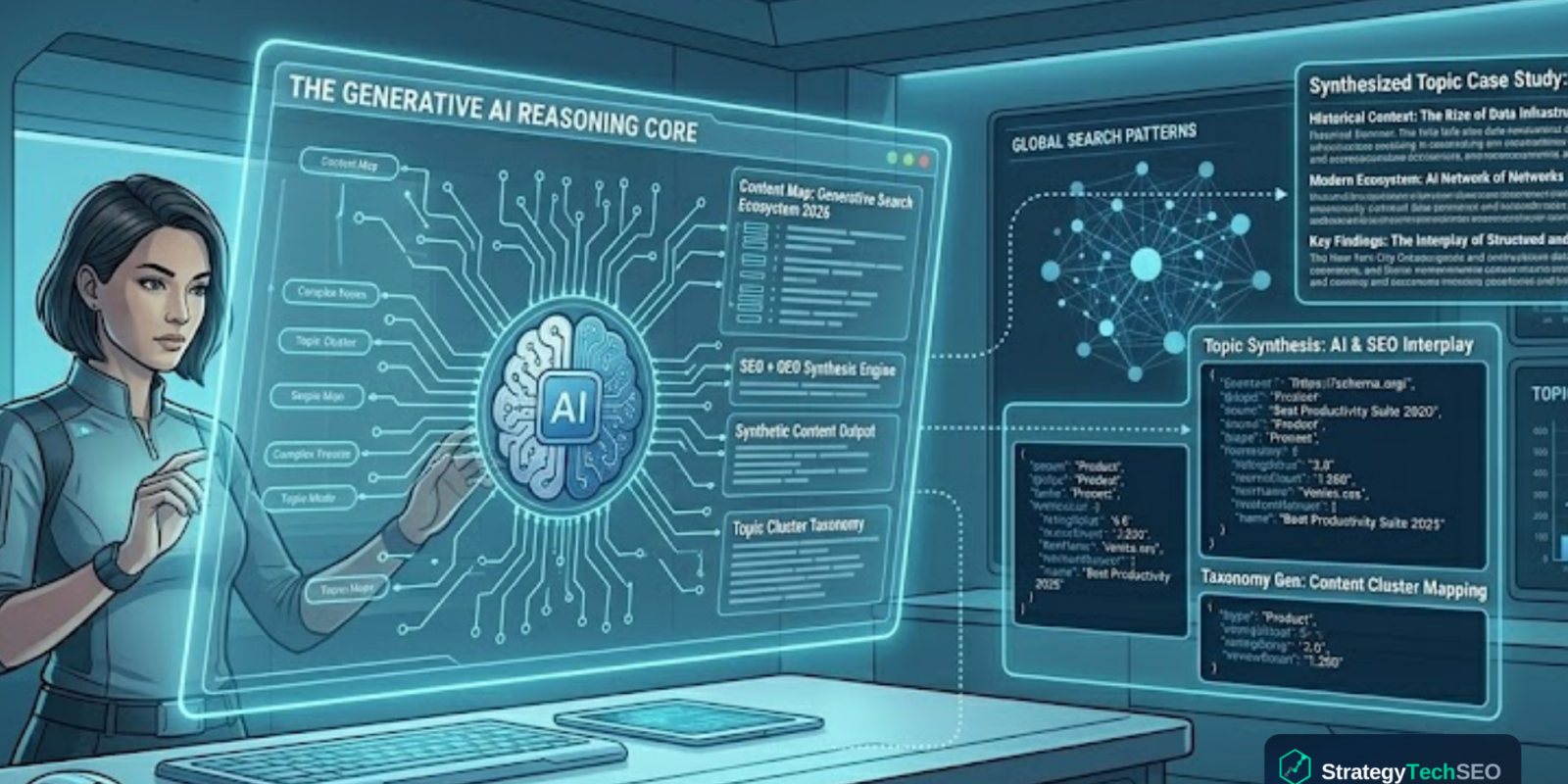
Each cluster page must incorporate structured data and schema markup so AI systems can programmatically interpret the relationships between your content.
Build a True Synthesis Hub
The pillar page must function as a genuine hub that integrates cluster content rather than simply aggregating links to subtopics.
Review Clusters Quarterly
Search habits shift. AI platforms change how they pick sources. A static content plan decays while an adaptive one compounds.
Setting Up Clusters for AI Visibility
Each pillar should aim at a core topic where you want to own the space. Under that pillar, build cluster pages that cover every question and intent a searcher might bring. Use internal links to tie each cluster page back to the pillar and to sibling pages in the same group. This builds a web of topic signals that both search engines and AI assistants can trace.
The tech layer matters just as much as the words. Add schema markup to every pillar and cluster page. Use Article, FAQPage, and HowTo schema types where they fit. Data shows that sites with solid structured data earn far more mentions in AI search results. When you nest related schema blocks to show how content pieces connect, AI citations rise by close to 40 percent.
Google, Microsoft, and ChatGPT have all publicly confirmed they use structured data to determine which content appears in AI generated content responses. Sites with properly implemented schema markup get cited 3.1x more often in AI Overviews.
Content Signals That Drive SEO Success in 2026
Search engines and AI systems judge content by signals that go well past keyword counts. Here is what counts most for SEO success across both channels.
Lived Experience & Original Perspective
AI generated content saturates every niche. The differentiator between authoritative content and commodity output is demonstrable expertise. Use proprietary data, firsthand case studies, and original frameworks that only come from doing the work. AI systems prioritize content with genuine human expertise.
Structured Data as a Visibility Multiplier
Schema markup is no longer optional. It has transitioned from an incremental SEO enhancement to a foundational requirement for visibility across AI platforms. Neglecting implementation means forfeiting measurable visibility opportunities.
Go Deep, Not Wide
A short post skimming ten topics will not beat a 1,500-word guide that fully answers one clear question. AI driven search rewards content that meets user intent head-on. The cluster model ensures every subtopic gets the depth it needs.
Clear Page Layout
Use sharp headings, a logical flow, and formatting that makes your content easy to scan. A page with a clean H2 and H3 structure tells AI systems your content is well-structured, trusted, and easy to extract answers from.
From Plan to Action
The gap between a plan and real results almost always lies in how you carry it out. Here is how to close that gap. Start with three to five core topics where you have real skill and business reason to rank. Map every keyword to an intent group within those topics. Build your pillar pages first, then add cluster content that fills each intent gap. Put schema markup in place from day one, not as a patch later.
Track success through metrics tied to intent, not just page views. Watch which intent groups drive sales, which pillars earn AI citations, and which cluster pages build the link weight that lifts the whole topic area. This turns your SEO strategy from a post-schedule into a system that grows over time.
Check your clusters every quarter. Search habits shift. AI platforms change how they pick sources. New questions come up around your core topics. A content plan that sits still loses ground. One that adapts keeps building.
- Publishing without an intent map. Every page should have a defined intent type and buyer stage before writing begins. Without this, you produce content that ranks but does not convert.
- Treating every keyword as a standalone page. Isolated pages compete with each other and dilute your topical authority. Group keywords into clusters that reinforce each other.
- Skipping schema markup. Structured data is now a baseline requirement for AI visibility. Pages without it are invisible to the fastest-growing search channels.
- Ignoring content architecture. A flat site with no internal linking structure signals nothing to AI systems. Build clear pillar-to-cluster link paths that machines can follow.
- Measuring only traffic. Page views without intent alignment are vanity metrics. Track conversions, AI citations, and link equity by intent cluster instead.
The Bottom Line
Building a content strategy for SEO in 2026 means seeing that output alone is not a plan. The teams that win organic reach this year will be the ones that map intent first, build linked topic clusters that AI systems can read, and add the page-level signals that earn spots in every search channel. Volume without structure is noise. Strategy without intent mapping is a guess. Put them together, and you build something that grows.
Build a Content Strategy That Actually Ranks
Intent mapping, topic clusters, and structured data are the foundation of modern SEO visibility. StrategyTech SEO builds content strategies that earn results across both traditional search and AI discovery channels.
Sources & References
- SEO Melbourne. “Search Intent Clustering for AI Overviews.” seomelbourne.com
- Topical Map AI. “Search Intent Mapping for Clusters: The 2026 Guide.” topicalmap.ai
- Mean CEO. “Content Cluster Mapping: Ultimate Guide for Startups.” blog.mean.ceo
- Medium. “How Structured Data Schema Transforms Your AI Search Visibility in 2026.” medium.com
- Digidop. “Structured Data: SEO and GEO Optimization for AI in 2026.” digidop.com
- Wellows. “Schema & NLP Best Practices for AI Search Visibility.” wellows.com
- Search Engine Land. “How Schema Markup Fits into AI Search.” searchengineland.com
- Atechnocrat. “Google AI Overview SEO 2026 Complete Optimization Guide.” atechnocrat.com

StrategyTech SEO
StrategyTech SEO helps businesses grow organic visibility through technical audits, on-page optimization, and data-driven search strategies. We turn SEO from guesswork into measurable results.