Zero-Click Searches SEO: How to Win Traffic When Nobody Clicks
The majority of Google searches now end without anyone clicking a single link. According to Semrush’s 2025 study, 58.5% of U.S. searches resolve entirely on the search engine results page. For marketers who have built their strategies around organic traffic, this is an uncomfortable number. But it is also misunderstood. Zero click searches SEO is not about losing visibility. It is about redefining where and how that visibility happens.
The instinct is to treat zero-click as a loss. If nobody clicks, nobody visits your site, and nobody converts. That logic made sense when the only path to a customer was through a blue link. It does not hold in a world where AI overviews, featured snippets, knowledge panels, and other SERP features display your brand, your data, and your expertise directly on the results pages where users are already looking.
This guide reframes the zero click trend and outlines search strategies that turn zero-click impressions into measurable brand value, downstream traffic, and conversions.
What Zero-Click Actually Means (and What It Does Not)
A zero-click search is any query that ends without the user clicking through to a website. The user finds what they need directly on the SERP through an AI Overview, a featured snippet, a knowledge panel, a People Also Ask answer, or a local pack result.
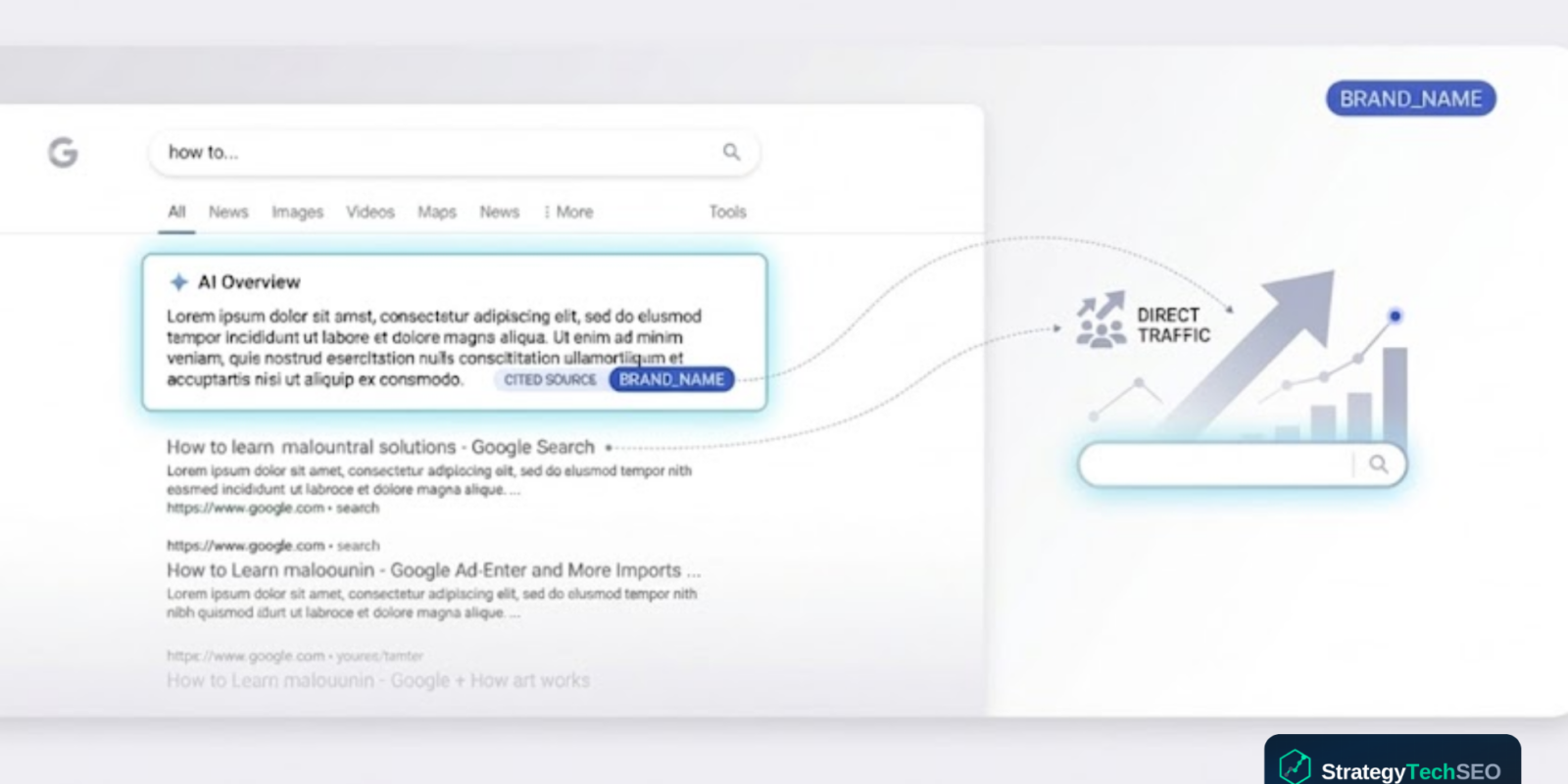
What zero-click does not mean is zero visibility. When your brand appears as a cited source in an AI overviews response, or when your content powers a featured snippets box, users see your brand name, your expertise, and your data. They absorb that information. They associate your brand with the topic. And that association has real, measurable downstream effects.
Research shows that sites consistently cited in AI-generated answers see 34% higher direct traffic and 28% higher branded search volume within 30 days. Those are not accidental correlations. They are the result of repeated brand impressions in the places where users now spend their attention: the SERP itself.
In a zero click world, the SERP is not a gateway to your content. It is a stage where your brand performs. Every AI citation and snippet appearance is a brand impression with measurable downstream value.
Why the Zero-Click Trend Is Accelerating
Three forces are driving the growth of zero-click searches.
- AI Overviews are expanding rapidly. Google’s AI powered answer boxes now appear on a significant and growing percentage of queries. When an AI Overview appears, the zero-click rate for that query jumps to 83%, compared to roughly 60% for queries without an AI Overview. As Google expands its AI overview coverage, the overall zero click trend will continue to climb.
- SERP features are consuming more real estate. Featured snippets, People Also Ask boxes, knowledge panels, local packs, and shopping carousels now dominate the above-the-fold area of most results pages. Users increasingly find their answers within these elements without ever scrolling to the organic listings.
- User behavior is shifting toward conversational search. Users are asking longer, more specific questions, often through voice assistants and AI search platforms. These high intent conversational queries are more likely to trigger direct-answer SERP features, further increasing the zero-click rate.
The trajectory is clear. Zero-click is not a temporary disruption. It is the new default for how people interact with traditional search engines.
The Downstream Value of Zero-Click Visibility
The biggest strategic mistake in responding to zero-click is treating impressions as worthless because they did not generate a click. That thinking ignores how the customer journey actually works.
A user who sees your brand cited in an AI Overview for “best CRM software for small teams” may not click your link in that moment. But when they later search for your brand by name, visit your site directly, or recognize your name in a comparison email, that initial impression is doing its work. This is the downstream value that zero-click visibility creates.
The metrics that capture this value look different from traditional SEO reporting:
| Metric | What It Measures | Why It Matters |
|---|---|---|
| Branded Search Volume | Searches for your brand name | SERP impressions build recognition; users begin searching for you directly |
| Direct Traffic Growth | Users navigating to your site directly | Invisible to keyword attribution but directly connected to SERP visibility |
| AI Citation Rate | How often your content is cited in AI answers | The new equivalent of ranking on page one for queries that matter |
| Share of Voice in SERP Features | Your brand’s frequency in snippets, panels, and PAA | Your brand’s share of attention on the search engine results page |
These metrics matter because they capture the value that zero-click creates. Ignoring them means you are measuring the wrong things and drawing the wrong conclusions about your SEO performance.
How to Win in a Zero-Click World
Winning in zero-click requires an SEO strategy that optimizes for visibility and citation, not just clicks. The core techniques are practical and build directly on existing SEO fundamentals.
Optimize for Snippets and PAA
Structure your content with clear, question-based headings, followed by concise 40 to 60 word answers. This answer-first format is what Google extracts for featured snippets and what generative AI models use when composing AI Overview responses. Every section should be self-contained enough for a search engine or AI model to understand your content and extract a complete answer.
Implement Structured Data
Structured data markup helps search engines and AI systems interpret your content with precision. Article, FAQPage, HowTo, and Organization schema types signal exactly what your content represents, increasing your eligibility for rich results and AI citations.
Build Topical Authority
Create hub-and-spoke content architectures that demonstrate deep expertise across a topic. Search engines and AI models both evaluate topical authority when selecting sources. A single page may earn a snippet, but a comprehensive content cluster earns consistent citation across multiple related queries.
Strengthen Brand Entity Signals
Ensure your brand name, descriptions, and key claims are consistent across your website, Google Business Profile, social media profiles, Wikipedia (if applicable), and third-party mentions. AI models build brand understanding through entity recognition, and consistency strengthens citability.
Target High-Intent Queries
Broad informational queries are the most likely to resolve in zero clicks. But high intent queries with commercial or transactional modifiers still generate clicks. Balance your strategy between visibility-focused content (targeting AI citation) and conversion-focused content (targeting queries where users are ready to act).
Create Click-Demanding Content
Not all content can be fully summarized in a snippet or AI answer. Interactive tools, calculators, original research, proprietary data, and personalized assessments require the user to visit your site. Build these assets as click magnets that complement your zero-click visibility efforts.
Measuring Success in the Zero-Click Era
Traditional SEO measurement frameworks are not built for the zero-click reality. If your reporting only tracks organic sessions and keyword rankings, you are missing the majority of the value your SEO efforts create.
Build a measurement framework that includes visibility metrics alongside traffic metrics. Track your AI citation rate, branded search trends, direct traffic patterns, and share of voice in SERP features. Compare these against your traditional organic metrics to build a complete picture.
The brands that thrive in the zero-click era recognize a fundamental shift in how search delivers value. The click is no longer the primary unit of success. The impression, the citation, the brand association that happens before the click is where the real compounding value lives.
Zero-click is not a crisis. It is an evolution. And the SEO strategy that embraces it will outperform the one that fights it every time.
Zero-click is not zero-visibility. It is zero-click-to-your-site, but not zero-impression. The brands that optimize for citation, snippets, and AI overviews are building compounding brand equity on the SERP itself.
Turn Zero-Click Into Brand Visibility That Converts
58.5% of searches end without a click, but that does not mean they end without value. StrategyTech SEO helps brands optimize for AI citations, featured snippets, and SERP visibility that drives downstream traffic and conversions.
Sources & References
- Semrush. “Zero-Click Searches Study: 58.5% of US Searches End Without a Click.” semrush.com
- Bain & Company. “Goodbye Clicks, Hello AI: Zero-Click Search Redefines Marketing.” bain.com
- Search Engine Land. “Guide to Zero-Click Searches.” searchengineland.com
- Forbes. “What Is Zero-Click and Why Is It Turning Marketing on Its Head.” forbes.com
- Siteimprove. “Zero-Click Search Strategy.” siteimprove.com
- Click Vision. “50+ Zero Click Search Statistics for 2026.” click-vision.com
- ALM Corp. “AI Overviews and Zero-Click Searches: Adapting Your SEO Strategy for 2026.” almcorp.com
- Go Fish Digital. “Zero-Click Search Is Now the Default in Enterprise Retail (2026 Benchmarks).” gofishdigital.com

StrategyTech SEO
StrategyTech SEO helps businesses grow organic visibility through technical audits, on-page optimization, and data-driven search strategies. We turn SEO from guesswork into measurable results.